LAHelpNow - AI-Powered Crisis Response System
Co-founded and designed an AI-powered digital assistant providing real-time, verified resources to people displaced by the January 2025 Los Angeles wildfires.
At a glance
The challenge
Education systems face unprecedented disruption from AI technologies. Yet conversations about AI in education often exclude resource-constrained communities and marginalized voices.
The problem wasn't just about access—it was about who gets to shape the conversation. Most AI education discourse excludes diverse perspectives. Research is often paywalled or proprietary, creating barriers to the very people who need it most.
Human impact
Thousands displaced overnight, including families with children. Complete loss of homes requiring critical decisions under cognitive overload.
System fragmentation
Existing disaster response systems were fragmented and overwhelming for people experiencing trauma.
Technical constraints
Immediate deployment required with risk of AI misinformation in life-or-death situations. Complex LLMs and RAG systems needed careful implementation.
Cultural sensitivity
Diverse LA communities required culturally sensitive design and multilingual support across dialects.
Constraints:
- Navigating the complex intersection of education equity, AI ethics, and implementation
- Ensuring methodological rigor while maintaining equity
- Creating conditions where all voices could be heard equally
The solution
What would research look like if it was designed for equity from the start? This question guided an 8-month collaborative initiative bringing together 75 experts at the intersection of education and artificial intelligence.
We secured sponsorship for a platform designed to facilitate anonymous and equitable live surveys. The innovation wasn't just technical—it was methodological. Anonymity changed participation because it changed the context of safety, not because people changed their views.
Human-centered AI design
Applied cognitive psychology principles for empathetic responses designed for trauma states. Centered on what people needed in vulnerable moments.
Rapid prototyping under crisis
Evolved from hackathon to operational NGO within weeks. Global volunteer team working across time zones.
Scalable crisis model
Designed for any disaster-affected region. Flexible architecture for limited-connectivity environments.
Multilingual accessibility
Real-time translation across 7 languages with dialectal variations. Voice-based interfaces for users with literacy constraints.
The result was a comprehensive open-source report detailing approaches to cultivating inclusive learning environments—a resource freely accessible to anyone. This challenged the assumption that knowledge should be proprietary when education is a fundamental right.
The process
Four-phase timeline from concept to published report.
Rapid needs assessment
Week 1Conducted ethnographic research with displaced populations. Collaborated with 12 humanitarian agencies to map information flows. Established ethical guidelines balancing privacy with immediate safety needs.
AI assistant design & development
Weeks 2-3Built advanced RAG system with multilingual knowledge base. Implemented real-time translation, low-bandwidth modes, and voice interfaces. Created factuality verification and escalation pathways.
Ethical AI implementation
Week 4Built safeguards against AI hallucinations using specialized retrieval strategies. Ensured trauma-informed responses with cognitive load considerations. Designed for accessibility and cultural inclusivity.
Deployment & iteration
OngoingLaunched functional NGO coordinating globally distributed volunteers. Established real-time monitoring and feedback collection that doesn't burden overwhelmed users.
The Challenge
January 2025 wildfires displaced thousands in Los Angeles. Existing disaster response systems were fragmented and overwhelming for people experiencing trauma.
The Solution
We co-designed “Lala,” an AI-powered digital assistant applying cognitive psychology principles for users in crisis. The approach centered on what people needed in their most vulnerable moments, not just what technology could do.
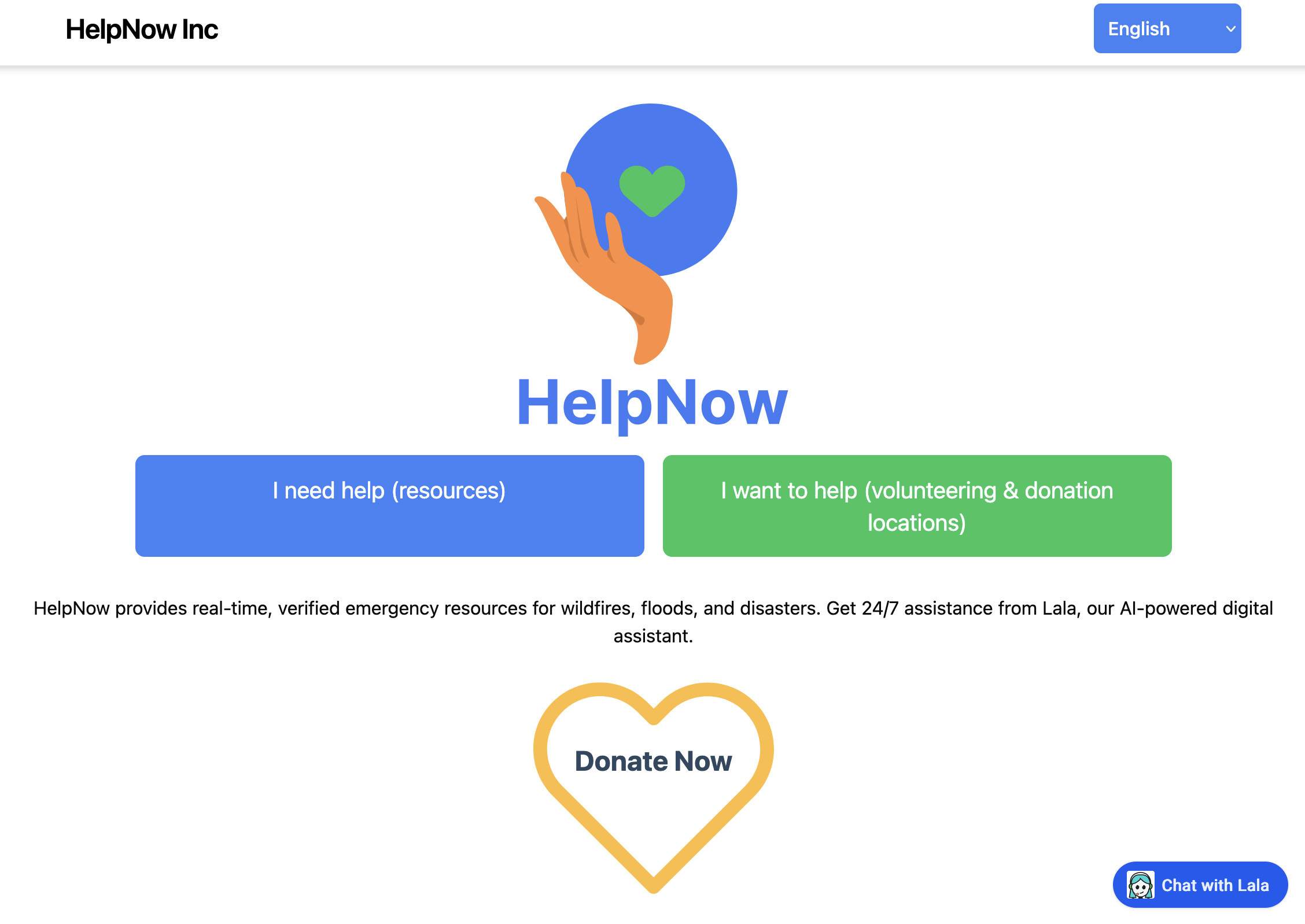
The landing page provides clear entry points: “I need help” for resources and “I want to help” for volunteering and donations. Lala, our AI assistant, offers 24/7 assistance with real-time, verified emergency resources.
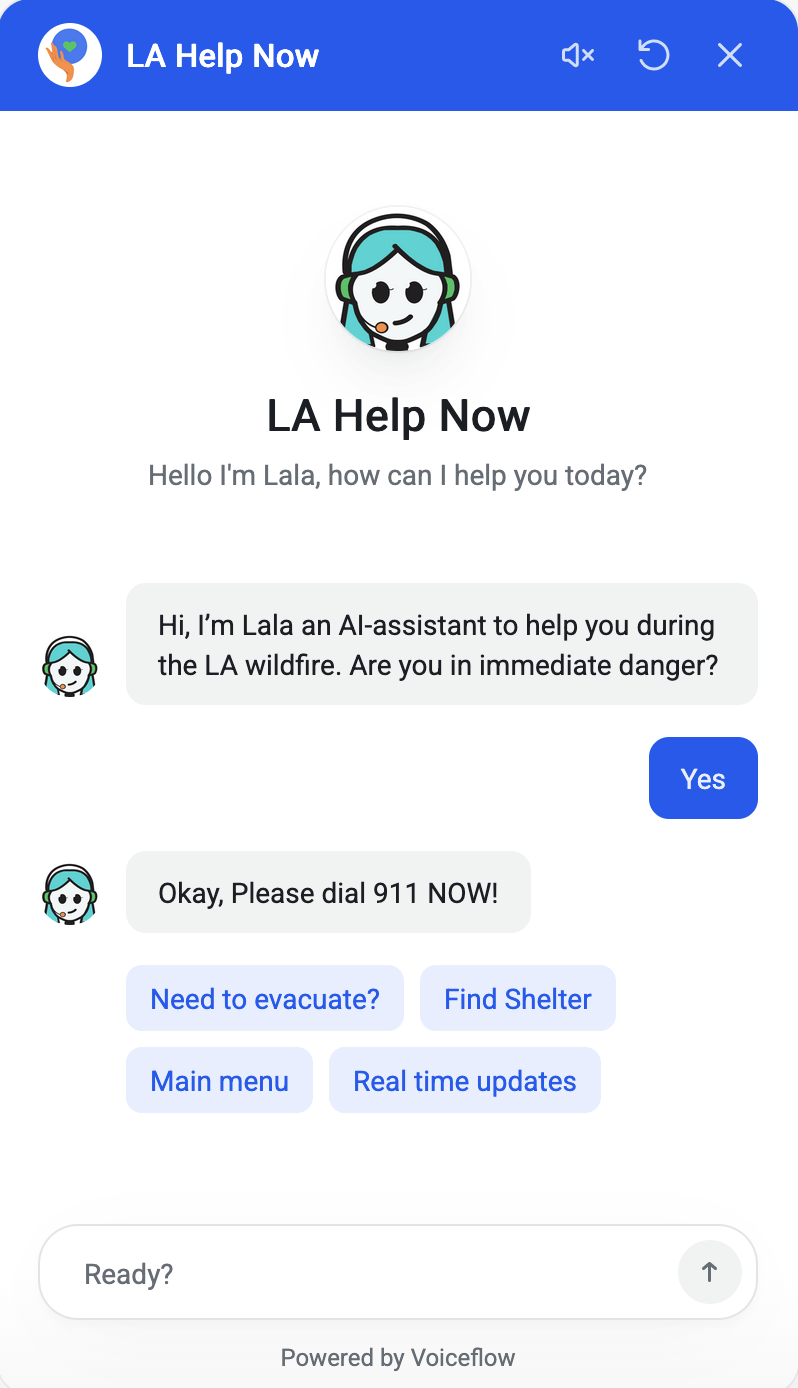
When users indicate immediate danger, Lala immediately directs them to call 911, then provides evacuation resources, shelter locations, and real-time updates.
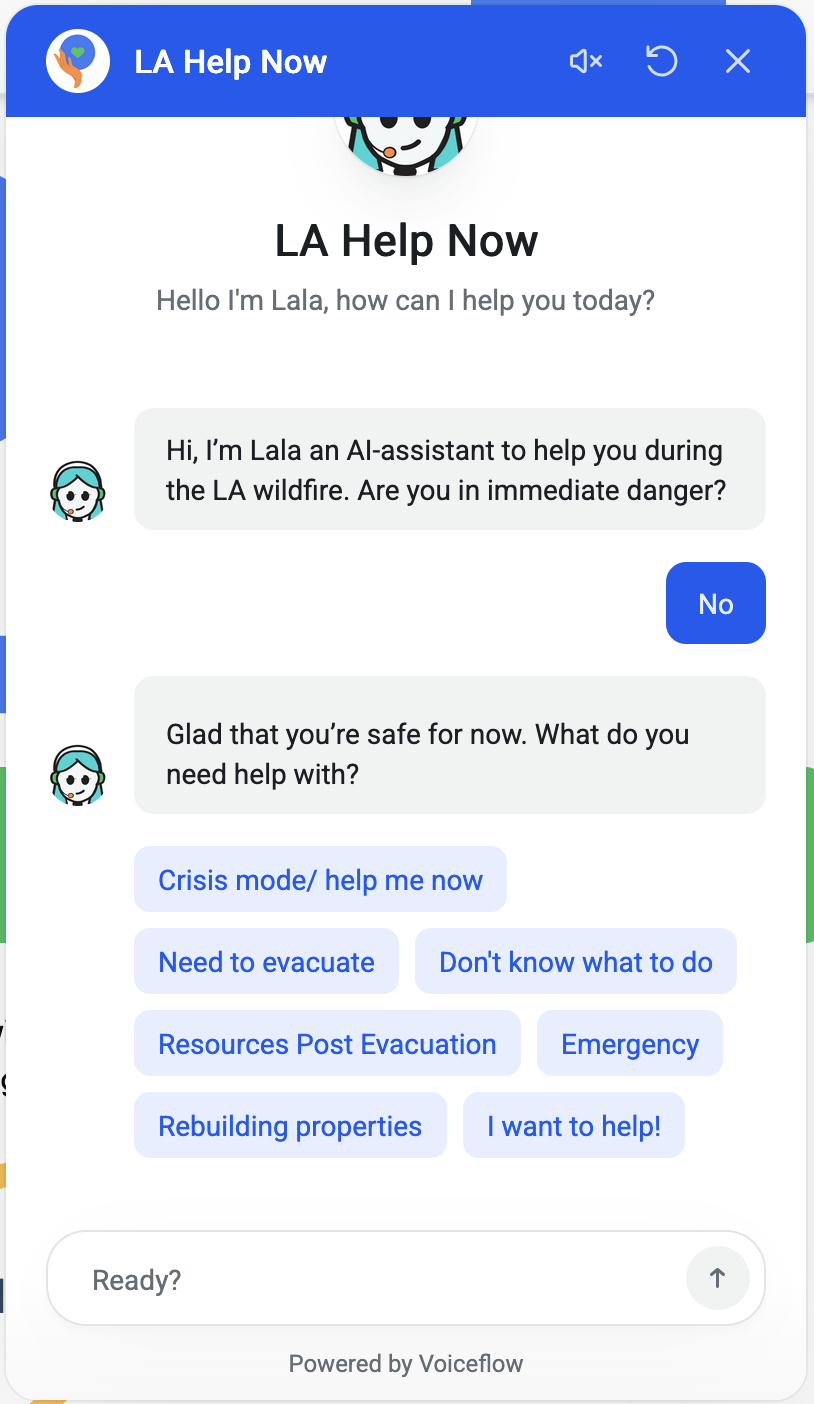
For users not in immediate danger, Lala offers structured help options including crisis mode, evacuation planning, post-evacuation resources, and ways to contribute.
The Process
flowchart LR
    A[Phase 1: Rapid Needs Assessment] --> B[Phase 2: AI Assistant Design]
    B --> C[Phase 3: Ethical Implementation]
    C --> D[Phase 4: Deployment & Iteration]
The Impact
Scale & reach:
- Transitioned from prototype to official NGO serving disaster-impacted communities
- Created scalable model applicable across any disaster-affected region
- Enabled real-time access to verified resources through conversational AI
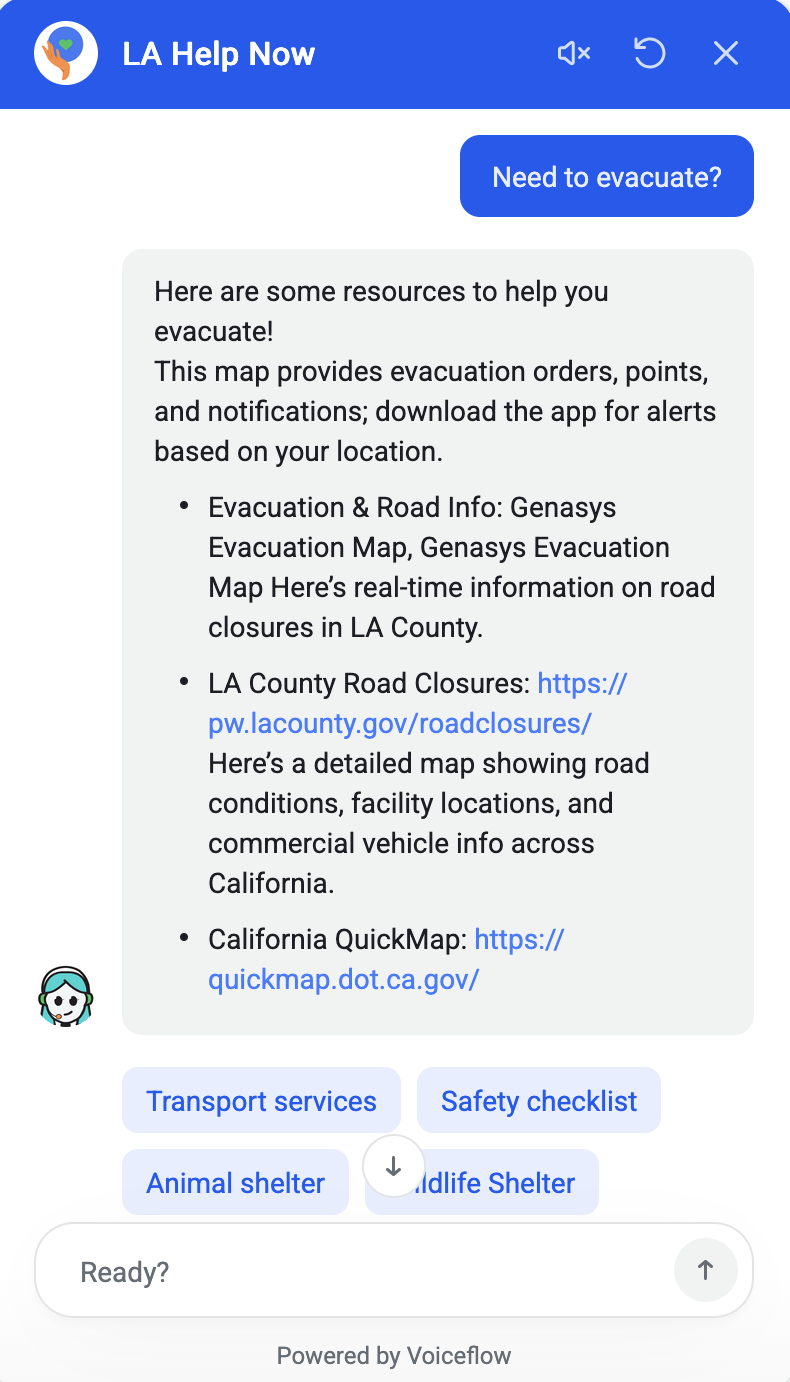
Lala provides comprehensive evacuation resources including real-time maps, road closure information, and step-by-step safety guidance.
Innovation:
- Pioneered conversational AI for real-world disaster response
- Created rapid deployment model for AI systems in crisis
- Established framework for empathetic, culturally-sensitive AI in high-stakes environments
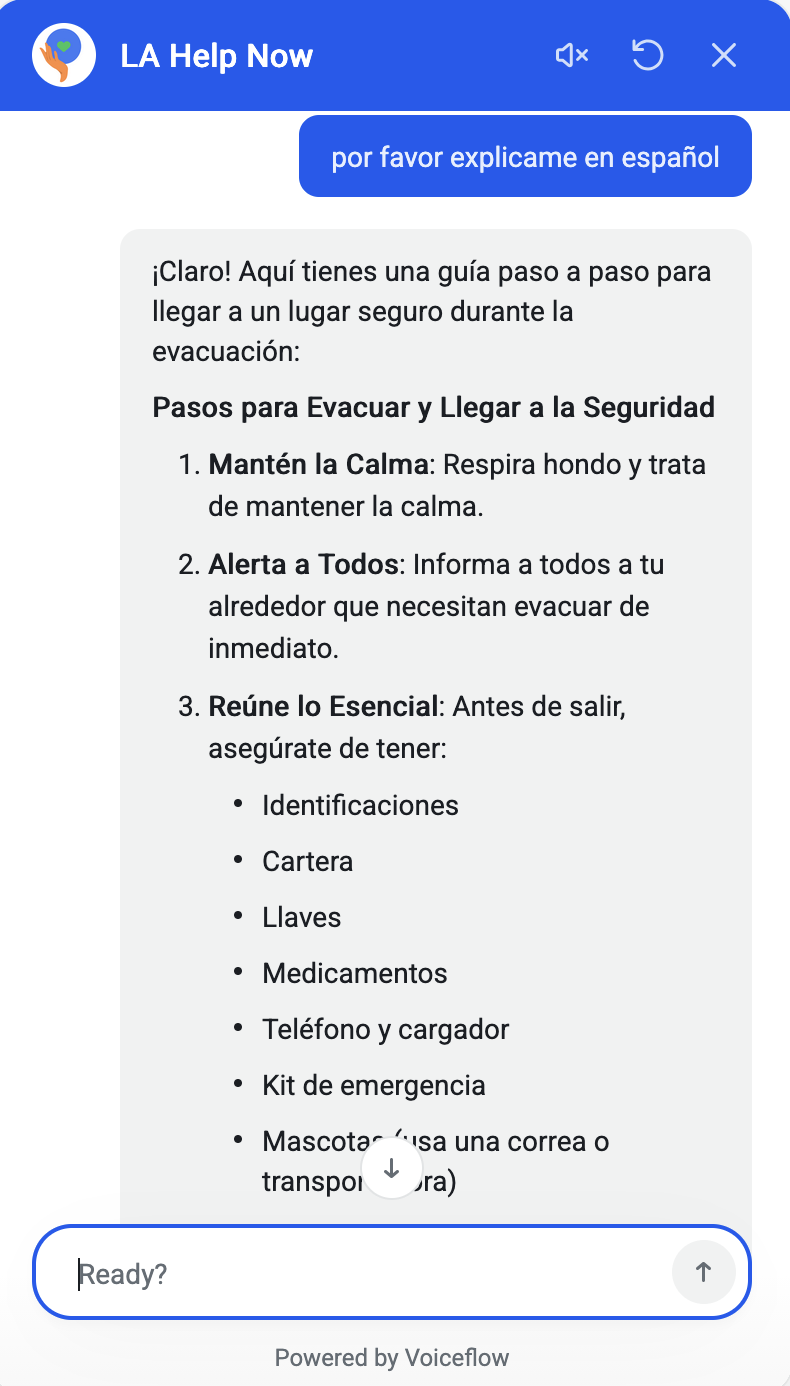
Multilingual support ensures critical information reaches diverse communities. Lala provides step-by-step evacuation guidance in Spanish and other languages, accounting for dialectal variations.
Recognition:
- Featured on UX Spotlight podcast (Userlytics, May 2025)
- Recognized as groundbreaking initiative in AI-driven crisis response
- Case study in ethical AI application during emergencies
Key Learnings
Ethical AI in crisis requires grounding in cognitive psychology and UX research. Rigorous methodology adapts to emergency timelines without sacrificing quality when we revisit assumptions about what “quality” means in crisis contexts.
Crisis-specific RAG requires specialized retrieval strategies. Information accuracy and contextualization matter more than conversational sophistication. Multilingual capabilities must account for dialectal variations and regional terminology.
Trust mechanisms must be explicitly designed for varying technical literacy. Hybrid human-AI approaches outperform either solution independently, but effective handoffs require careful consideration.
Privacy protections must balance with immediate safety needs. Successful humanitarian AI requires deep collaboration between technical teams and domain experts, creating spaces where different perspectives inform each other.
The Insight
Technology can serve people in their most vulnerable moments—but only when human psychology and real-world needs are centered from the start. By applying cognitive load theory to design for extreme stress states and ensuring trauma-informed responses, we found that ethical AI in crisis isn’t about choosing between speed and quality—it’s about redefining what quality means when lives are at stake.
This project demonstrated that combining conversation design, UX research, cognitive psychology, and AI/ML creates breakthrough solutions. Speed must always be balanced with inclusive design, especially during crisis, because the people who need help most are often the ones most easily excluded.
Reference: Userlytics. (2025, March 5). Using AI for positive impact [Audio podcast episode]. UX Spotlight Series. https://www.userlytics.com/resources/podcasts/using-ai-for-positive-impact/